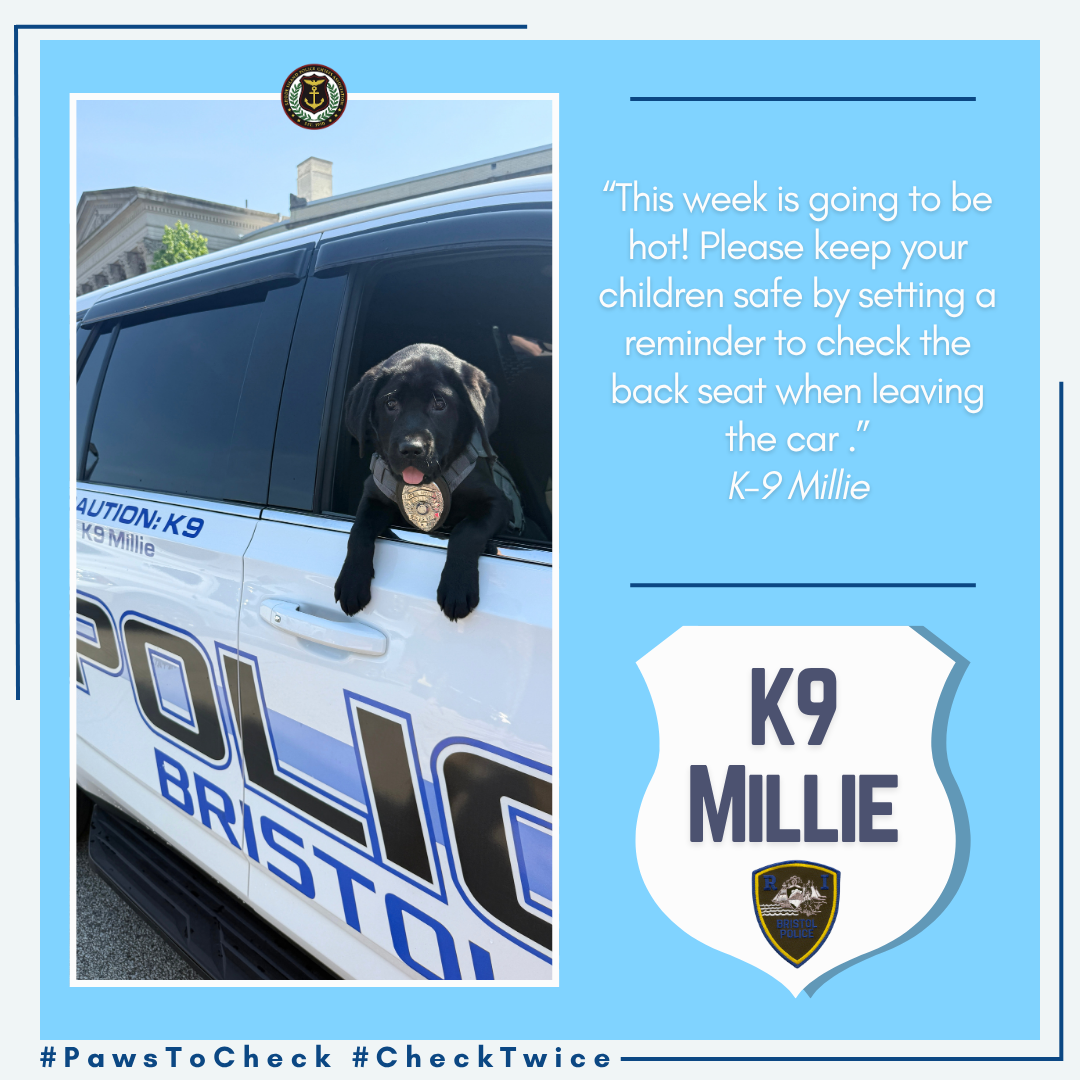
"Check Twice and Save a Life"
Rhode Island Police Chiefs Association reminds Rhode Islanders about the danger of hot cars
This summer, the Rhode Island Police Chiefs Association will highlight the dangers of hot cars with its “Check Twice and Save a Life” campaign. The initiative will feature K-9s from around the state delivering their "Paws to Check" message and will include tips to help educate parents and guardians to create the habit of checking the backseat before leaving a vehicle on a hot day.
"Our goal is to prevent even one hot car tragedy this summer by reminding everyone how quickly these incidents can happen," said Colonel Michael Correia, President of the Rhode Island Police Chiefs Association and Chief of the Barrington Police Department. "Leaving a child or pet in a vehicle—even for a few minutes—can have devastating consequences. On a warm day, the temperature inside a vehicle can climb more than 20 degrees in just 10 minutes, turning an ordinary errand into a life-threatening situation. A few simple precautions can save a life."
K-9 Millie from the Bristol Police Department is the lead dog in the social media campaign. At just 3 months old, she is the state's newest comfort dog.
______
What is Hyperthermia?
Hyperthermia is a medical condition that causes the core body temperature to rise dangerously above the normal body temperature ( 97 F to 99 F for adults, 95.9 F to 99.5 F. for children, and around 101.5 F for animals) as a result of the body absorbing or producing too much heat than it can release. Heatstroke is the most severe case of hyperthermia.
Background on Hyperthermia
In the U.S., more than 1,000 children have died from heatstroke in the last 25 years. 31 children died of heatstroke in vehicles in 2025, according to the National Highway Traffic Safety Administration (NHTSA).
1/4 of hot car deaths happen because a child was trapped in a car (NHTSA).
In Rhode Island, it is illegal to leave a child under the age of seven in a vehicle for an extended period of time, and it is also illegal to leave an animal in a car in extreme temperature conditions. Under the Good Samaritan law in Rhode Island, it can be considered legal to use reasonable force to get into a car to save a life
Penalties for leaving an animal in life-threatening conditions include:
Up to a $1,000 fine
Up to 1 year in prison
Or Both
Information on Hyperthermia and prevention will be featured on the Association's social media accounts throughout the summer and early Fall.
All are encouraged to like and share our posts:
Facebook: @richiefsofpolice
Instagram: @ripolicechiefs
X: @ripolicechiefs
###
Contact:
Cara Cromwell
(401) 440-0090